Economic Constellations: Connecting İzmir's Seven Districts
A working paper by Koray Velibeyoğlu and Tilbe Kurt reads İzmir as a constellation of seven specialised districts and sets out who connects them, in what order, and how EABID members can take part.
İzmir has strong universities, many specialised economic districts and a relatively effective culture of public-private partnership. A new working paper by Koray Velibeyoğlu and Tilbe Kurt describes this innovation capacity as rich and fragmented, with centres that operate as separate islands. Many district managers will recognise the paper's summary: “The districts do not at present know one another systematically; the links among them depend on individual relationships.”
The innovation-district model that Katz and Wagner described in 2014 is a single, dense, walkable area. For a polycentric city like İzmir, the authors set a different task: designing a working order of links among the centres that already exist. They call the result a constellation.
Seven districts that grew on their own
Alongside designed centres such as İzQ and the technoparks, İzmir has seven economic districts that developed spontaneously. Each grew where an early cluster or a locational advantage set off growth that then reinforced itself:
- ●Kemeraltı, the historic city centre: crafts, trade and cultural heritage
- ●Alsancak port hinterland: creative industries
- ●Yenişehir, the commercial centre: wholesale trade, construction and food
- ●Pasaport-Çankaya: ICT firms
- ●Mimar Kemalettin: fashion and textile design
- ●Karabağlar-Sarnıç: furniture manufacturing
- ●İnciraltı-Balçova: blue and green infrastructure, with a marina, a faculty of marine sciences, an urban forest and the EXPO botanical infrastructure
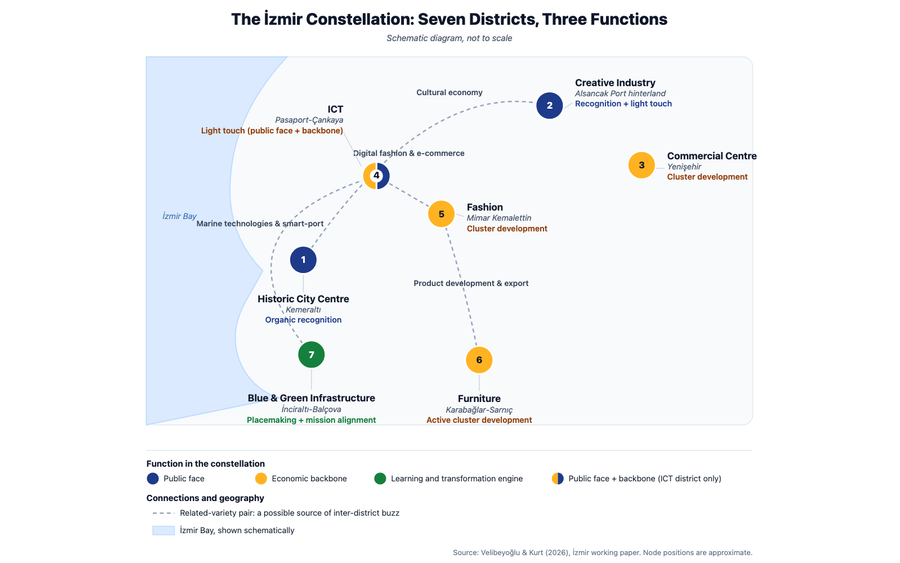
The districts lie far apart, so everyday contact does not reach from one to another by itself. In the paper's reading, they already have economic assets. What they lack are network assets and a reorganisation of their physical space, and both come from connecting them. No district has to become an innovation district in its own right: through the connecting structures described below, each can contribute to the whole as what the authors call a constellation node.
Three functions, and a different intervention for each
The seven districts do different jobs for the city. Kemeraltı, Alsancak and Pasaport-Çankaya carry the public face: they produce visibility, encounter and social legitimacy. Yenişehir, Mimar Kemalettin and Karabağlar-Sarnıç form the economic backbone, providing production, supply and sectoral depth; Pasaport-Çankaya belongs here as well. İnciraltı-Balçova is a case of its own, a learning and transformation engine: a living lab and a direct channel to international networks.
The paper also assigns each district a type of intervention. Kemeraltı calls for organic recognition, Alsancak for recognition and a light touch, Pasaport-Çankaya for a light touch. Yenişehir and Mimar Kemalettin call for cluster development, Karabağlar-Sarnıç for active cluster development. For İnciraltı-Balçova the paper proposes placemaking together with mission alignment. Some districts, in other words, mainly need to be acknowledged as part of the whole, while others need a full cluster programme.
Any city can put the same two questions to its own districts: what does each one give the whole, and how much intervention does it actually need?
Where the buzz comes from
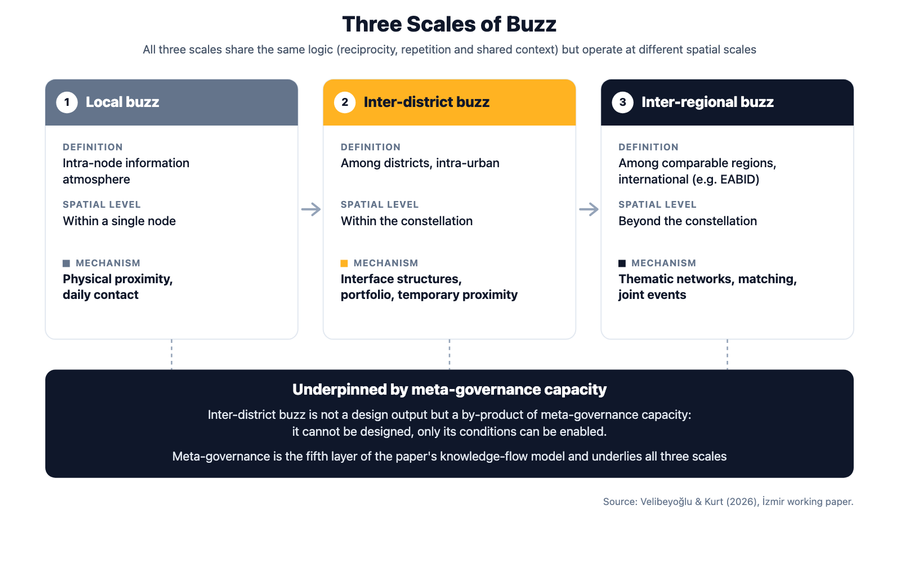
Economic geographers distinguish local buzz, the spontaneous flow of information among people who work close together, from global pipelines, the deliberate and costly channels that reach selected partners far away. The paper adds two terms. Inter-district buzz is knowledge that flows between districts “within the same city yet not within walking distance, deliberate like a pipeline yet not as costly”. Inter-regional buzz is reciprocal learning between comparable regions abroad, of the kind EABID exists to support. All three scales of buzz work on the same logic of reciprocity, repetition and shared context. They differ in where they happen and in what sustains them.
Where should a city look for this buzz? The paper points to related variety: interaction between sectors that are neither wholly different nor identical. In İzmir it names four pairings. Fashion and ICT open onto digital fashion and e-commerce platforms. Kemeraltı's crafts and the creative industries open onto the cultural economy. Furniture manufacturing and design open onto product development and export capacity. The blue economy and ICT open onto marine technologies and smart-port systems. Making these links visible and lasting is the first task of the connecting structures.
Inter-district buzz, the paper stresses, “cannot be designed; only its conditions can be enabled.” It separates the deliberate links between districts, which it calls inter-district pipelines, from the buzz those links make possible. The conditions it names are interface structures, a shared portfolio of projects, and occasions for people to meet in person, which the literature calls temporary proximity. Behind them sits what the paper calls meta-governance: “governing the environment in which actors govern one another”.
Distance matters too. Following Boschma (2005), the paper treats geographical, institutional, organisational, social and cognitive proximity as partly interchangeable: ties built by the connecting structures can make up for the distance between İzmir's centres. Too much proximity carries its own risk of lock-in. And the time it takes to reach another centre is part of the cost of innovation.
The portfolio comes from a finance layer the paper adds to the four familiar components of place-based development (policy, innovation, leadership and placemaking). Drawing on the Place-based Transition Funds approach (Howard et al., 2024), it proposes a portfolio of mutually reinforcing projects, blended finance and loan guarantees to make early-stage ventures bankable, and ownership that passes gradually to local civic structures. The portfolio also gives otherwise separate actors a common language.
Who connects the districts
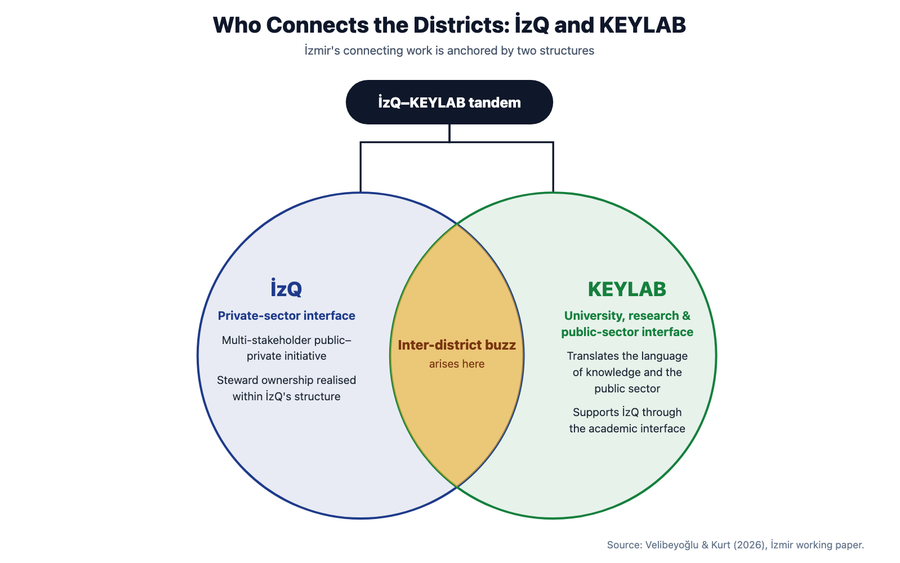
The proposed architecture is anchored by two structures. İzQ, a multi-stakeholder public–private initiative already attuned to the city's sectoral missions, is the connecting structure for the private sector. KEYLAB is the interface for the universities, other research institutions and the municipality: it translates the language of knowledge and of the public sector, supporting İzQ through that academic interface. The two speak different institutional languages, and the paper expects inter-district buzz to arise where they meet.
The steward-ownership model the paper calls for is realised on the İzQ side: İzQ is itself a multi-partner city initiative, so meta-governance capacity is built within that existing structure rather than inherited from a single agency.
Three stages, starting from existing institutions
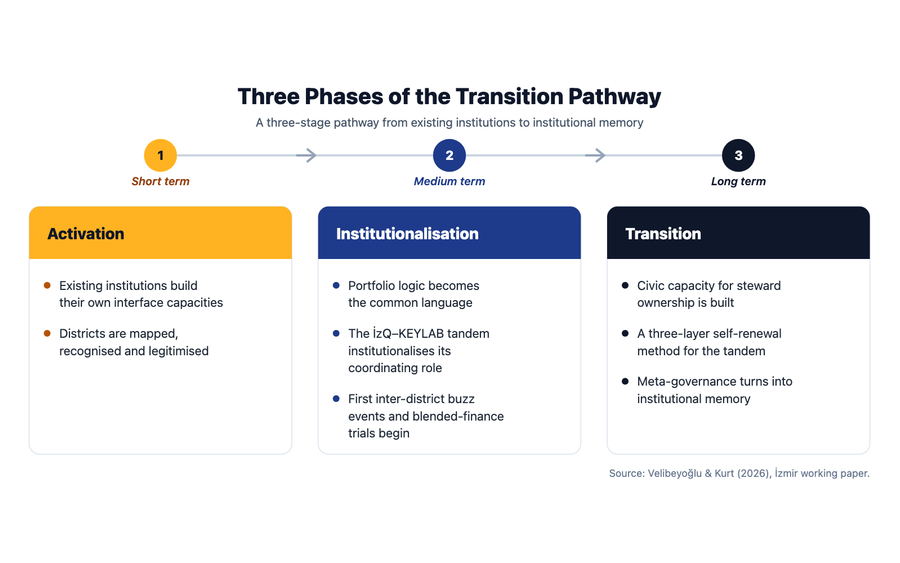
The paper starts from a practical constraint: at the outset nothing can begin without the means of existing institutions. The path it proposes uses those institutions without staying captive to them, and it does not start from scratch either. The authors call this path creation. It runs in three stages:
- 1.Activation (short term). Existing institutions build their own interface capacities. The districts are mapped, recognised and legitimised.
- 2.Institutionalisation (medium term). Portfolio logic becomes the common language. The İzQ–KEYLAB tandem institutionalises its coordinating role. The first inter-district buzz events and blended-finance trials begin.
- 3.Transition (long term). Civic capacity for steward ownership is built within İzQ. A three-layer self-renewal method is put in place for the İzQ–KEYLAB tandem — a written protocol, an annual open session that updates priorities with majority community and sector approval, and an ad-hoc arbitration panel that resolves disputes within a fixed period — and meta-governance becomes institutional memory.
How to start
Map the districts, and keep mapping. The paper treats mapping as a living process. It warns against using administrative boundaries, which can split a concentration that crosses a boundary or lump two distinct clusters together. The minimum it proposes for İzmir: start with interviews tied to places on a map, then use spatial social network analysis to see which people act as bridges and which centres are cut off. The second step also tests whether inter-district buzz is happening at all.
Record what the districts learn. Indicator rankings are designed for mature systems, so for a region still in transformation the paper recommends process-based approaches at three levels: how much the centres interact and reflect together, how tacit experience is turned into a case others can compare, and how deep the learning goes. The second level also shapes how İzmir packages what it learns for EABID. The third asks: did we adjust how we work, or did we change the assumptions behind it?
Begin with placemaking. Of the four place-based components, placemaking is the least developed in practice and the one most open to early, concrete action. It is project-based and site-specific, which suits a task-and-finish team: a team set up for one bounded, outcome-oriented job, using the means of existing institutions. İzmir's first application would be İnciraltı-Balçova, where the marina, marine-sciences faculty, urban forest and EXPO botanical infrastructure offer a ready living-lab setting to prepare the physical ground for inter-district buzz.
What İzmir brings to EABID
The paper sees İzmir's outward links as two rings that share one logic. The national ring is the proposed national-scale reading of intra-urban economic districts: once mapped in cities beyond İzmir, comparable spontaneous districts can be read as prototype “intra-urban innovation districts,” with specific parts of them converted into inner city innovation districts, corridors or nodes. The aim is not for municipalities to compare notes but to build a new-generation understanding of intra-urban innovation at national scale, and to boost the economic clusters each city already has under way. The international ring is EABID. Both depend on the work at home, because “the value of a collection of laboratories depends on the laboratories speaking to one another.”
The paper distinguishes this kind of exchange from a global pipeline, through which a region either imports knowledge or sells it. Inter-regional buzz is reciprocal and repeated, between regions that share similar challenges, such as Mediterranean port and blue-economy regions.
It sees İzmir's value to the network on two axes. On diversity, İzmir offers seven laboratories at once, each with its own sectoral logic and its own path from spontaneous district to constellation node, for other members to observe and compare. The authors say plainly that there is no mature, proven model to show yet. Following Morgan's (1997) work on learning regions, they locate a region's value in its capacity and speed of learning.
On scale, İzmir exceeds many European cities in population, which makes it a reference case at near-national scale. A significant share of EABID members are smaller cities with one or two such districts. They will eventually meet the problem İzmir faces now: coordination grows more complex as scale increases. İzmir can give them a working preview of that, and in return learn from the focus and agility of smaller members.
İzmir's participation in EABID's network, pursued through İzQ, is one of the pathways the paper's authors point to for the city's international opening.
Take part: the survey and the working group
The paper's appendix contains a tool for the whole network: the EABID Placemaking Survey, a general framework designed for all EABID members. The 23 questions are grouped in seven sections: general information, identity and vision, physical placemaking, community and ecosystem, governance and collaboration, innovation and experimentation, and challenges and future directions. The aims include mapping placemaking practice, measuring the value of physical places and identifying areas for future collaboration.
The final question asks whether respondents would be interested in joining a shared EABID placemaking working group. EABID members can fill in the survey and use that question to say whether they want to take part.
Based on: Velibeyoğlu, K. and Kurt, T. (2026). “Thinking a Polycentric Geography of Innovation: Inter-District Buzz and a Place-Based Transformation Model in the Case of İzmir.” Working paper, June 2026 (not yet published, available from the corresponding author upon request).

Koray Velibeyoğlu
KEYLAB (Izmir Urban Innovation Laboratory), Izmir University of Economics, Department of Architecture

Tilbe Kurt
KEYLAB (Izmir Urban Innovation Laboratory), Izmir University of Economics, Department of Architecture
European Association of Business and Innovation Districts (EABID) — www.eabid.eu