
From talk to action: EABID at the OPENVERSE sandboxes webinar
Graham Colclough at the final OPENVERSE webinar: innovation districts, task and finish teams and a 28th Regime sandbox for virtual worlds.
On 26 October I joined the final OPENVERSE webinar on regulatory sandboxes for virtual worlds. My message was simple: Europe's problem is not innovation, it is scaling; and the fragmentation across Europe is a real inhibitor to our economic competitiveness on a worldwide stage. Business & Innovation Districts are where we can tackle this, as they represent a significant proportion of the economy. And EABID is keen to carry the good work of the OPENVERSE forward.
A busy panel, one shared question
OPENVERSE is a three-year Horizon Europe support action on Virtual Worlds – a topic that spans entertainment to infrastructures. It is coordinated by Fabio Perossini of the Lisbon Council, and closes on 31 October. This was its final webinar, moderated by Arta Ertekin of Martel Innovate.
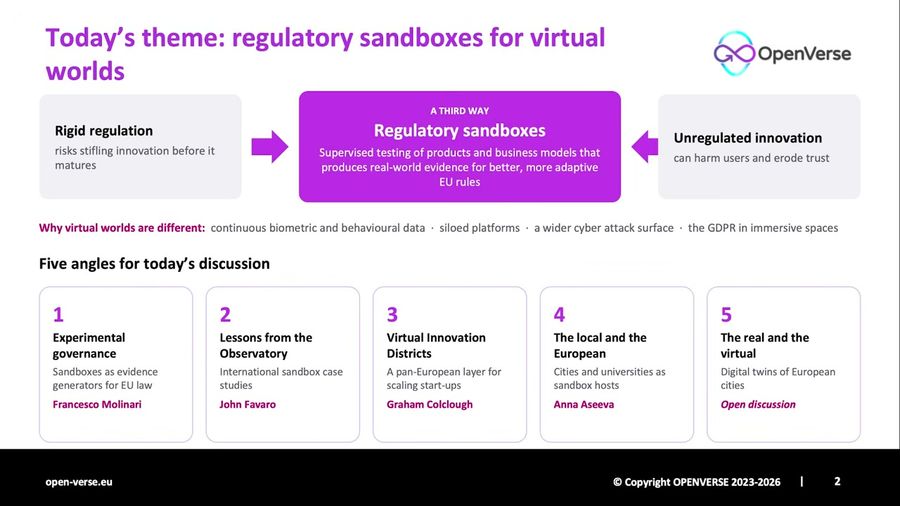
The panel addressed sandboxes from several angles:
- ●Francesco Molinari (Lisbon Council) set the scene. Regulation is too slow and too sector specific, so we need institutions that learn while the technology is still being shaped.
- ●John Favaro (Trust-IT Services) walked us through the OPENVERSE Observatory, a very handy collection of sandbox initiatives, open to all, failures included. Most failures simply petered out for lack of financing.
- ●Anna Aseeva (Digital for Planet) made the case for cognitive sandboxes that test with real consumers how we can ensure AI interfaces don't compromise fair and safe digital spaces.
- ●Jan Wester (LDT CitiVERSE EDIC) explored how sandboxes can keep isolated yet good pilots out of the "pilot graveyard".
My slot was about the players. Who actually takes this forward, on the ground, across Europe?
Isolated economic islands
The Draghi and Letta reports tell us plainly that we are lagging in competitiveness and we are fragmented. In essence, we operate as isolated economic islands. Both across member states, and within member states as innovation districts.
And innovation districts matter. In most member states they represent a significant double-digit share of GDP. In Spain, the figure is 53% of national GDP. In Oeiras Valley, not far from Lisbon, somewhere between 15 and 20% of Portugal's GDP sits in that one location.
So if we want to improve the lot of Europeans, we need to focus on these vital economic ecosystems.
Europe's problem isn't innovation. It's moving startups – the source of that innovation – into scale-ups, and making sure they don't go off to the States. Which, in large part, means in search of money.
EABID: an action shop
The European Association of Business and Innovation Districts is new. We launched in Brussels in March this year. We are very ambitious and hugely delivery-focused. We don't want to be a talking shop. We want to be about action and delivery.
Around 20 districts form our starting core, spanning north, south, east and west of Europe, of all sizes, and every level of maturity. The big cities and big innovation districts can often speak for themselves. Our particular focus is collaboration amongst the mid-sized locations, because together they represent a large proportion of the economy.
We deliver through task and finish teams. That term is used on purpose. A task and finish team comes to an end. It is not a committee that gets formed and continues forever. Five are in process:
- ●Revitalising Industrial Parks, because a lot of the European economy still sits in the rump of industrial parks. They need infrastructure upgrades through to skills to embrace innovation and modern technologies like AI.
- ●Place-Based Innovation: understanding how the constellations of innovation within a region or city actually operate and how to stimulate the buzz to support them.
- ●National Innovation Blueprints: ask yourself what your country's blueprint is – then consider whether it really works. With 27 nations and no common view, there is room for a shared taxonomy, so we can compare, learn and improve.
- ●Stimulating Investment: startups that want to scale too often get their funding from America. How do we stem that flow and liberate the right combination of funds from within Europe?
- ●The 28th Regime, which is where virtual worlds come in.
The 28th Regime and a virtual innovation district
Francesco and I have a joint paper in draft. It has two parts.
Part A covers vision and policy. It explores EABID as a delivery vehicle for the Commission to support the 28th Regime that Letta proposed. That is our answer to Letta's challenge of fragmentation and Draghi's challenge of competitiveness: a European way of doing things on the economy, on digitalisation and, to Anna's point, on people feeling comfortable with their data. In essence, EABID as a virtual innovation district, a service provider at European level.
Part B proposes to land it on the ground with four practical sector demonstrators, each a sandbox:
- ●renewable energy storage
- ●digital health
- ●drones
- ●and Virtual Worlds
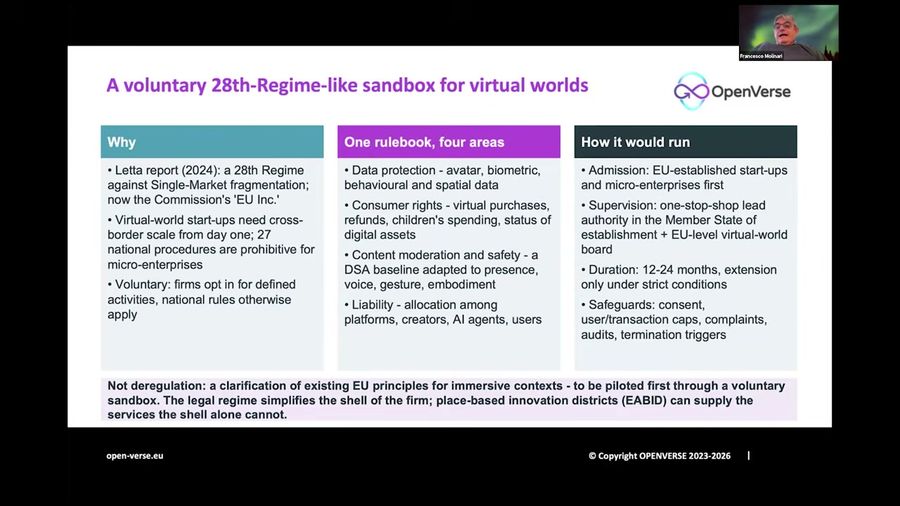
Francesco said regulation is too slow and sector specific. So, we picked four very different sectors, to explore commonalities and differences, and use the sandbox concept to make swift practical improvements by district demonstrators collaborating across Europe's delightfully different landscape.
Francesco's own slide put it neatly: "The legal regime simplifies the shell of the firm; place-based innovation districts (EABID) can supply the services the shell alone cannot."
What comes next
For the Virtual Worlds demonstrator, the idea is that around half a dozen EABID members form a task and finish team to explore a sandbox specific to virtual worlds. OPENVERSE has done a lot of very good work, and its Observatory is exactly the evidence base we need.
As OPENVERSE closes, EABID wants to pick up and expand what the project has built and, in effect, act as a delivery arm for it. Next steps:
- ●finalise and publish the joint Molinari/Colclough paper on the 28th Regime
- ●host a Brussels-based workshop to align with and enrol key players there
- ●bring the four demonstrators to life through EABID task and finish teams
- ●keep the conversation going with OPENVERSE partners, where the synergies are obvious
A new organisation, a genuine opportunity to do something 'the European way', and clear synergies with OPENVERSE. Now, time to get on with it!
Watch the full recording: Regulatory Sandboxes for Virtual Worlds Innovation (my contribution starts at 28:31).

Graham Colclough
Mentor in Chief, UrbanDNA
Providing strategic guidance and mentorship from decades of experience in urban innovation and smart cities.
LinkedIn ↗European Association of Business and Innovation Districts (EABID) — www.eabid.eu